




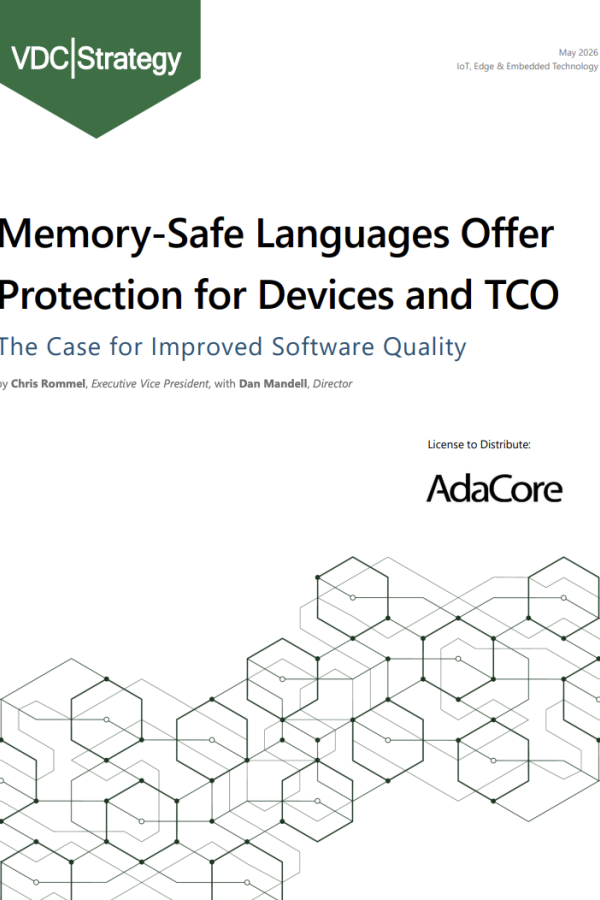
Memory-Safe Languages Offer Protection for Devices and TCO
The Business Case for Memory-Safe Languages
85% of engineers say programming language choice directly impacts safety and security, and regulators are taking note. This independent report from VDC Strategy, based on a survey of 500+ embedded engineering decision-makers, examines why memory-safe languages like Ada, SPARK and Rust have become the leading choice for safety-critical development, and what that means for your risk, schedule and bottom line.

What You'll Learn
Backed by real survey data, the report quantifies the impact of language choice across the full product lifecycle. See why memory-safe language projects report development costs 2X–4X lower than C and C++, how Ada teams are 4X more likely to deliver ahead of schedule, and how organizations reduce lifecycle patch and defect costs by 60% or more. It also unpacks the regulatory drivers reshaping the field, and how memory-safe languages help meet standards like DO-178C, IEC 61508 and ISO 26262.
Ready to Put Memory-Safe Languages to Work?
AdaCore helps engineering teams build safe, secure and reliable software with Ada and SPARK. Talk to us about what memory-safe development could mean for your next safety-critical project.
Hear the Findings Straight from the Analysts
The report gives you the numbers. This session gives you the argument. Chris Rommel of VDC Strategy walks through what 500+ embedded decision-makers actually reported, then AdaCore Chief Product Officer Quentin Ochem translates it into practice: what memory safety looks like on real safety-critical projects, how it supports certification, and why it's becoming the foundation for trusting AI-generated code.
9 September 2026 · 16:00 BST / 17:00 CEST / 11:00 EDT
Can't join live? Register anyway and we'll send you the recording.