





CubeSat Prototype using a NEORV32
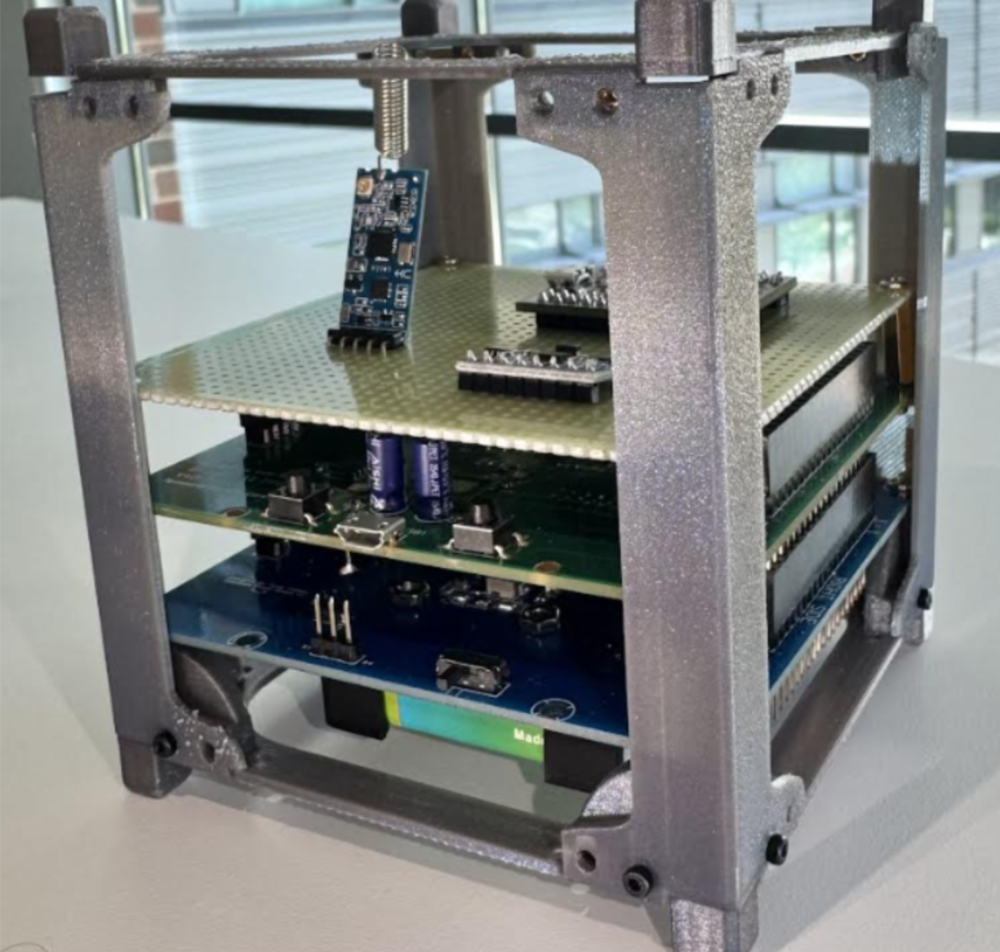
A six-student capstone team at George Mason University built a CubeSat prototype spanning the full stack, from a custom power stage to an IMU interfaced with a NEORV32 RISC-V soft-core running Ada firmware, streaming telemetry to a ground station for live 3D visualization. The project took home the Best Project award.
George Mason
A six-student capstone team at George Mason University, Tariq Aldalou, Abdullah Hagi, Anas Alyaseen, Said Rahali, Kareem Nweashe, and Colin Stables, built a CubeSat prototype spanning the full stack a real satellite needs: a custom power stage to feed the electronics, an IMU interfaced to a NEORV32 RISC-V soft-core on FPGA running Ada firmware, and a telemetry link to a remote ground station that renders the streamed IMU data as a live 3D visualization, watch the prototype move, and its digital twin moves with it, in real time. Working with AdaCore through the GNAT Academic Program, the team took home the Best Project award.
It's a compelling architecture bet at student-budget cost: an open RISC-V core synthesized onto an FPGA, sensor drivers, and telemetry in a language built for high-integrity systems, the same pattern flying in real spacecraft avionics.
The platform groundwork is open on GitHub: a curated NEORV32 bring-up covering the Digilent Basys3 under Vivado with the GNAT Academic Program's Ada HAL wired in and the complete Alire-to-bootloader firmware workflow documented for Linux and Windows. Their Basys3 setup even patches the upstream processor top at project-creation time rather than forking it, keeping their platform in sync with the NEORV32 mainline.